

Quick Summary
Fantasy art craftsmanship is the sum of the decisions a maker or manufacturer puts into a piece: composition, texture and detail, colour and finish, and presentation. At DragonZone Australia, we explain it as a way of reading a piece rather than a guarantee about how it was made. What you can judge is what you can see.
- Examine a piece in three passes: overall impression, detail consistency, then finish and stability.
- View at arm's length first, then close up, to see if composition reads clearly.
- A cast figurine, printed canvas and diamond art kit can each be executed well or poorly.
- Keep pieces out of direct sunlight and dust gently with a soft dry cloth.
- Handle pieces by the base rather than protruding details to avoid damage.
Table of Contents
- What Fantasy Art Craftsmanship Actually Means
- Reading the Visual Story: Composition, Detail and Atmosphere
- Fantasy Art Collecting Tips: How to Examine a Piece Before You Buy
- Understanding Craftsmanship Across Different Fantasy Art Formats
- Caring for Fantasy Collectibles
- Appreciating the Craftsmanship Behind Fantasy Art
- Frequently Asked Questions
What Fantasy Art Craftsmanship Actually Means
Fantasy art craftsmanship brings together the creative and practical decisions that shape how a piece looks, feels and presents itself. From the composition of an illustration to the sculpted details of a dragon figurine, each element contributes to the overall impression.
At DragonZone Australia, we think appreciating craftsmanship begins with learning to look beyond the subject itself. A striking dragon might immediately catch your attention, but closer inspection can reveal interesting details in its scales, wings, pose and decorative finish.
Craftsmanship also takes different forms. An original illustration, a reproduced artwork, a sculpted ornament and a creative activity kit each involve different processes and skills.
Importantly, an attractive finish doesn't automatically mean an item is handmade, and a manufactured collectable isn't necessarily less appealing than an individually created piece. Understanding fantasy art craftsmanship means appreciating what you can observe while recognising what requires additional information about the artist or manufacturer.
Reading the Visual Story: Composition, Detail and Atmosphere
Composition arranges a scene so your eye travels where intended, around a clear focal point supported by secondary detail. Atmosphere comes from lighting, and fine detail holds up when you look closely at scales, feathers, fabric folds and foliage.
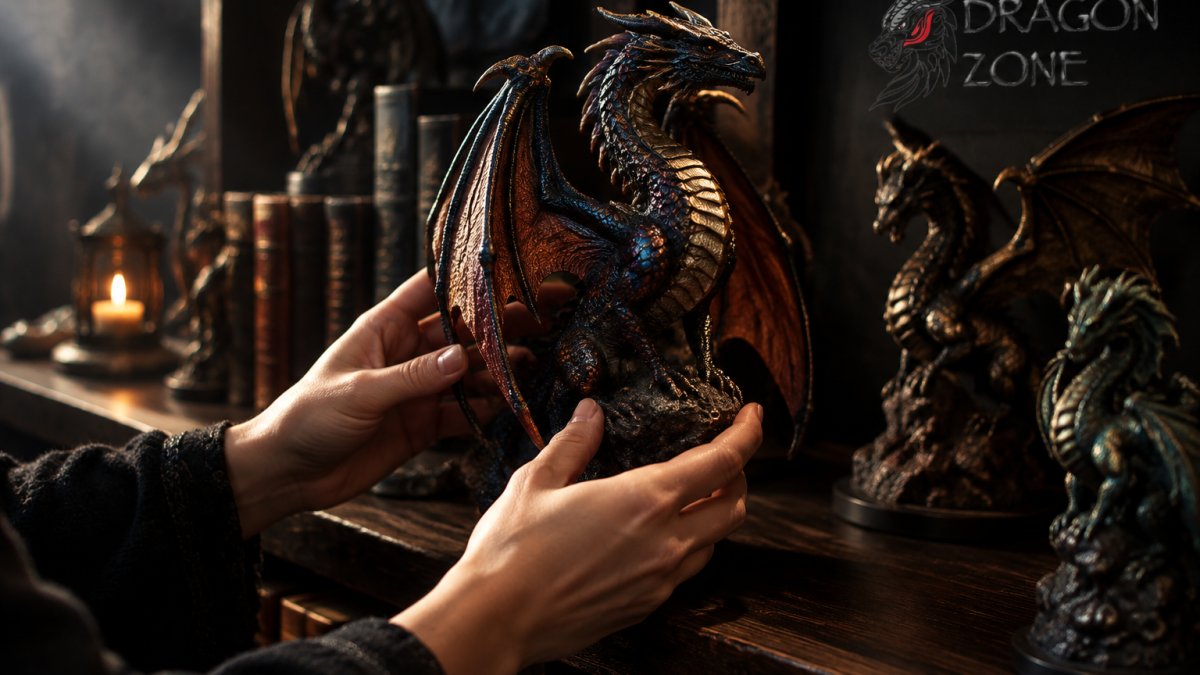
View a piece at arm's length first, then close up; if the composition reads clearly from both, the maker thought about how it would be seen. Browsing a single artist's range is more instructive than jumping between styles, see the Anne Stokes fantasy artist collection, where recurring motifs become easier to spot the more pieces you compare.
Fantasy Art Collecting Tips: How to Examine a Piece Before You Buy
Examine a piece in three passes: overall impression, then detail consistency, then finish and stability. Look for even paint coverage, clean edges where colours meet, symmetrical features where symmetry is intended, and a base that sits flat without rocking.
What none of this proves is authenticity, durability or how the item was manufactured. If you are weighing a reproduction, it helps to understand what licensed fantasy art prints involve, and these steps to start a fantasy art collection on a budget give you a practical order of priorities. For a deeper method, our guide on how to identify authentic fantasy art walks through the questions to ask before committing.
A simple three-pass approach keeps an inspection focused on what you can actually observe.
Pass |
What to check |
What it tells you |
|---|---|---|
Overall impression |
View at arm's length first |
Whether the composition reads clearly |
Detail consistency |
Even paint coverage, clean edges, symmetrical features |
Whether detail holds up close |
Finish and stability |
Base sits flat without rocking |
Whether the piece displays stably |
Understanding Craftsmanship Across Different Fantasy Art Formats
Fantasy artwork appears in many forms, and each offers different details for collectors to appreciate. Understanding these differences can help you choose pieces that suit your interests and display space.
Fantasy Illustrations and Art Reproductions
Illustrations rely on composition, colour, lighting and visual storytelling to create an atmosphere. When examining a reproduction, look at how clearly the artwork is presented, whether important details remain visible and how the image works within its chosen format.
A reproduction is not the original artwork, but it can still be an enjoyable way to display an artist's designs.
Sculpted Dragon Figurines and Ornaments
Three-dimensional collectables offer something different: the opportunity to appreciate a design from several angles.
Look at how a dragon's wings connect to its body, how the scales and facial features are represented, and whether the pose creates a convincing sense of movement or character.
Decorative finishes can also influence the overall appearance. Colour transitions, highlights and textured surfaces may draw attention to particular details, although appearance alone cannot confirm the production technique.
Creative Kits and Fantasy Craft Projects
Creative activity kits allow collectors to participate in making a decorative piece rather than simply displaying a finished product.
For example, the Anne Stokes Crystal Creations Water Dragon design introduces a hands-on approach to fantasy artwork. The finished appearance depends partly on the care taken during assembly, making the creative process part of the experience.
Whether you prefer illustrations, figurines or craft projects, the most useful question is how successfully the finished piece communicates its design and whether it appeals to your personal collecting interests.
Caring for Fantasy Collectibles
Looking after fantasy artwork is another part of appreciating its craftsmanship. Delicate sculpted details, decorative finishes and printed surfaces may require different handling and cleaning methods.
Start by checking any care instructions supplied with the individual product. Where appropriate, use a gentle, material-compatible dusting method and avoid unnecessary pressure on fragile details such as wings, horns and claws.
Choose stable display surfaces away from areas where ornaments are likely to be knocked. Consider exposure to direct sunlight, moisture and heat, particularly when displaying artwork or collectables for extended periods.
For more detailed advice, explore our guide on how to care for fantasy statues.
A little attention to display conditions can help you enjoy the details that attracted you to a piece in the first place.
Appreciating the Craftsmanship Behind Fantasy Art
Understanding fantasy art craftsmanship is about learning to appreciate the creative details that make each piece distinctive. Whether you're examining a dragon figurine, admiring an illustrated fantasy scene or completing a decorative craft project, composition, texture and presentation all contribute to the experience.
Taking time to examine these features can help you become a more thoughtful collector without relying on assumptions about manufacturing methods or authenticity.
At DragonZone, we enjoy helping fantasy enthusiasts discover artwork and collectables that reflect their interests. Explore different styles, compare the details and choose pieces that continue to capture your imagination.
Frequently Asked Questions
What defines quality in fantasy art figurines?
Quality in fantasy art figurines is judged by several observable things rather than a single marker. Look at detail consistency across the whole piece, not just the front: scales, claws, folds and facial features should read clearly from multiple angles. Check the finish for uneven patches, visible seams or loose flakes. A stable base and balanced pose matter too. These observations tell you how the piece presents, but visual appearance alone cannot prove durability, authenticity or how it was made, so treat them as a starting point for your own judgement.
How can I tell the difference between an original artwork and a reproduction?
An original artwork is the artist's own created piece, while a reproduction is a copy made from it, often printed or cast. The distinction usually comes down to documentation and labelling rather than appearance. Check the product listing for clear attribution to the artist and the manufacturer, and read how the item is described. A reproduction can still be well made and attractive. If a listing does not state whether something is original or reproduced, ask before buying rather than assuming, and avoid treating a polished surface as proof of origin.
Why is artist attribution important in fantasy collectibles?
Artist attribution tells you whose vision you are bringing into your collection and helps you understand the style you are drawn to. For licensed work, the listing should clearly name the artist and distinguish them from the manufacturer and the retailer. Attribution also helps you build a coherent collection around artists whose work you follow. Treat attribution as information to verify from the product page, not as a guarantee of quality or value. Clear labelling is simply good practice for any collector comparing pieces.

0 comments